Brand profile
Brand profile (under Workspace in the sidebar) is where you tell the tool who this brand is — and where you sign off on what counts as true. When a brand is created, the tool automatically researches it from its URL: it crawls the brand’s own site and runs cited web research, and every fact it finds carries a source. Everything on this screen is a draft until you approve it — discovered is not the same as true. For a brand added through the guided setup, the first identity and fact-sheet approval happens right in that flow; this page is the same data afterwards, where it all stays editable and re-runnable.
Discovery
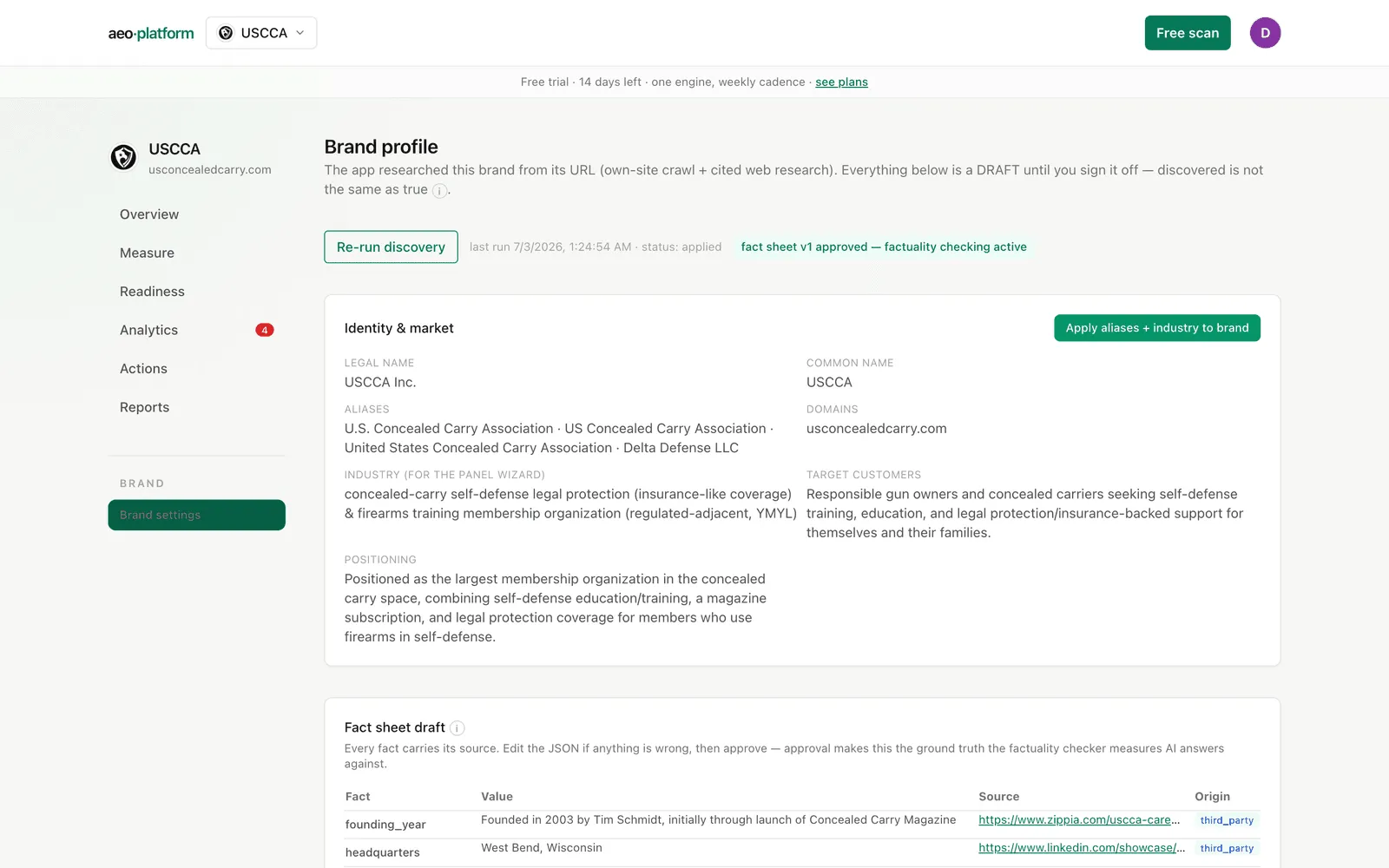
Section titled “Discovery”At the top, a Run discovery (or Re-run discovery) button with the last run’s date and status. Discovery runs automatically for new brands; for existing brands, or after a big change to the brand’s site, hit the button — results appear in a minute or two. Once a fact sheet is approved, a green badge here confirms it: “fact sheet v2 approved — factuality checking active.”
Identity & market
Section titled “Identity & market”The researched identity: legal name, common name, aliases, domains, an industry description, target customers, and positioning. The Apply aliases + industry to brand button copies the aliases and industry into the brand record so mention detection and the panel wizard use them. Nothing is applied until you click.
The fact sheet — the one approval that matters
Section titled “The fact sheet — the one approval that matters”The fact sheet draft is a table of discovered facts, each with its value, a link to the source it was lifted from, and an origin badge (from the brand’s own site vs a third party). Below it, the same facts sit in an editable text box: fix anything wrong, remove anything you cannot vouch for, then click Approve as ground truth.
Approval is the switch. Until a fact sheet is approved, factuality checking stays off — the tool never grades AI answers against unverified research. From the next check onward, every stored AI answer that discusses your brand is compared against the approved facts.
Discovered competitors and testimonials
Section titled “Discovered competitors and testimonials”Two side-by-side cards from the same research:
- Discovered competitors — each with its domain and a one-line “why.” Already-tracked ones show a tracked chip; the rest get a one-click Add button that puts them in the tracked set below.
- Testimonials (verbatim) — quotes found in the brand’s material, with attribution and a source link. Useful raw material for Studio work.
Brand Entity Map
Section titled “Brand Entity Map”An audit of roughly 16 surfaces where your brand identity lives (knowledge panels, directories, profiles — a missing Wikidata entry is a typical finding), checked for consistency against the canonical brand record. Each row shows the surface, its state, what was actually found there, a severity (5 = wrong founding date, founder, or category; 3 = metadata drift; 1 = stale), and a concrete fix. It re-audits quarterly; if it has not run yet, the card says so plainly.
Key claims and research material
Section titled “Key claims and research material”The claims discovery flagged as factuality-check candidates, plus an honest inventory of the material behind everything above: how many of the brand’s own pages were crawled and how many research citations were gathered. If the site blocked part of the crawl, that note appears here too.
Brand facts — what AI believes vs the approved record
Section titled “Brand facts — what AI believes vs the approved record”This is the payoff of approval. Before a sheet is approved, the card says so honestly: factuality checking is off — it only ever measures answers against an approved fact sheet. That is the tool being truthful about an unflipped switch, not a bug.
Once approved, it shows two tables:
- The approved record — your ground-truth facts, each with its source.
- What the engines get wrong — verbatim claims lifted from stored AI answers that contradict your approved facts, grouped by identical statement, with the engines that said it, how many times, a severity (high = pricing- or compliance-relevant), and when it was last seen.
Mismatches are observed, never modeled: exact sentences from real stored answers, not paraphrases. If every checked answer matches, the card says all accurate with the count; if none have been checked yet, it says checking fills in from the next completed run.
Tracked competitors
Section titled “Tracked competitors”The set every question is measured against — mentions, citations, share of voice, co-mentions. Add one by hand (name + domain) or promote a discovered one above. Each competitor carries two toggle chips:
- Direct | SERP — a true rival vs something that merely outranks you in search results.
- brand | publisher — publishers (review sites, media) tend to get cited, brands tend to get mentioned, so the label helps you read the results correctly.
Both are labels for interpretation; the measurement itself is identical for every competitor.
Related
Section titled “Related”- Why approval matters: fact sheet in the glossary.
- Where competitors show up: Scorecard rankings.
- The honest-empty principle: mental model.